Wednesday, May 29

Ask me no questions

Feynman recounted another good one upperclassmen would use on freshmen physics students: When you look at words in a mirror, how come they're reversed left to right but not top to bottom? What's special about the horizontal axis?
xkcd - Sky Color
A quick note, the xkcd strip on the left [src] reminds me of one of the underlying premises in the Science of Discworld books, "lies to children".

How we often make narratives more important than the actual facts, so as to make it easier to understand, remember and repeat.

And in part how even those who "get" a field have a hard time explaining it in terms that a kid can relate to.

The devils in the details - like the human body being at the same time 70% water, and 90% microbes...


Tuesday, May 28

Zen and the estrangements of mankind


Part 1 (on work v passion) and then part 2 (on mental models), makes this the third part in the flow of the book, but the fourth written and posted.

Unusual behavior tends to produce estrangement in others which tends to further the unusual behavior and thus the estrangement in self-stoking cycles until some sort of climax is reached. @1253


Part 2 ended with an idea left unsaid. And it was too soon. It is easier now, another year on from that day, our 9/11 - 227, or 7/22. 


July 22nd 2011 will probably live on for quite some time as a reminder. But even the most horrible dates fade over time, "never again April 9th" - reflecting on the way Norway was invaded by Germany and caught unprepared in 1940.

Yet it is a saying almost gone from our mind. And 70 years later we were in fact more or less taken unprepared.

By a single man. 

And his vision of the present, the future and the defining moments.


Not crazy, at least not crazy in a judicial definition - so he is serving his time. But somehow he entered into his own "world", and step by step built up a "vision" that lead him to, step by step, assemble a plan - and then a rationalization in the form of a mash up manifesto. I read parts and skimmed parts in the hours and days after 227, but have been unable, unwilling, to open it afterwards. It is best left for history, as it gives little else than a varnish atop a narrative oh so bewildered.


Which, in a strange way brings us back to ZEN - and the journey back into a life gone for our guide
He was insane. And when you look directly at an insane man all you see is a reflection of your own knowledge that he’s insane, which is not to see him at all. To see him you must see what he saw and when you are trying to see the vision of an insane man, an oblique route is the only way to come at it. [ibid, 1406]
It certainly seems like a good definition of insanity; when it is something we can't grasp, when we need to shift our mental models "one step left" in order to even grasp the outlines of the story.

Yet only a few pages previous, there is this passage;
We could not possibly be conscious of these things and remember all of them because our mind would be so full of useless details we would be unable to think ... We take a handful of sand from the endless landscape of awareness around us and call that handful of sand the world [ibid, 1370]
Is the world even real, beyond our sampling insights or fragments of reality? Like the Matrix, it could all be a simulation. Or at the very least suffer from a solid selection bias?

We see and react to what we all can live with around us, as opposed to the jarring discomfort of unwanted elements. Like beggars, how much simpler to ignore them actively or passively, letting their strange haven under the bridge be a hidden sight, their needs and encroachment on our daily bustle.

Like science and philosophy. Most people go on their merry way rather uncaring and untouched by the big questions. Does that make them more or less real, pressing, true?

Monday, May 27

Quality of Zen

In some ways this is the third post in the 'reading' series, but since I'm skipping to the end of Part II for this one, I'll try to add it into the flow later when the gap is closed. That is, covering the parts from around location 900 up to 3000 - and seeing how much still makes sense, in so far as the book makes any sense in and of itself.

So, close to the end of part II - we are back at the old school, revisiting the forgotten past - and having memories come back, along with some of the core ideas;

"What is quality in thought and statement?”

Quality…you know what it is, yet you don’t know what it is. But that’s self-contradictory. But some things are better than others, that is, they have more quality. But when you try to say what the quality is, apart from the things that have it, it all goes poof! There’s nothing to talk about. But if you can’t say what Quality is, how do you know what it is, or how do you know that it even exists? If no one knows what it is, then for all practical purposes it doesn’t exist at all. But for all practical purposes it really does exist. Location 3003

Quality is intangible  it is not something we can easily measure - although many characteristics related to, or derived from quality can. Durability. Workmanship - as a lack of errors, a precision in production and an adherence to spec. Yet so dominating and impactfull a concept. 

Quality is how we define and refine our positions. We like to think we make good choices. And by extension  think that quality is what we prefer. But why do we prefer it- for any given value of it? Is it the sum of the parts, the overall feeling, the little details? 

How has branding taken over the role of quality and entertainment the role of reflection? 

Brands were in parts created when we stopped buying direct. When we didn't any longer have a face to face relationship with the man who made our candle, we had need of a way to differentiate and remember. Both as seller and buyer. 

But now? 

When it is the same factories, using many of the same components that make our gear? Can you brand a pure experience, like using software? Or does it take a product you can hold and compare?  This could be why the iOS volume has been so great compared to previous pc/laptop. The touch experience makes the app and the content tangible in a different way. Makes it yours, even if it is shared by millions. 

How many people used to created, in the age of radio? And the early days of television, was it overflowing with people filming their own shows? No, the dream of a participatory society is probably just that. "Most people" don't discuss politics, but how their team did and how dinner tasted - not the ecological impact of using that brand of beef.

By that extension, is price an indicator [of quality] or simply a rationalization to signal intent and aspiration in a broader context? Most books cost the same, and seeing one movie over another isn't likely to get you a discount. But in subtle ways there is a price indication in play. Watching TV at home is cheaper than going to the movies, which is again outpaced by seeing a play. 


- ...and the sun brought me out, and the idea drove me inside, for it was one of those times...
[soundtrack: Volta - by Bjørk, faded down to set or keep the mood]

Sunday, May 26

Stop paying attention

(c) Dilbert - Scott Adams 


[Dilbert]
Is a nice way to round of this batch of posts - and for the schedule to round off the week with it.

Do you ask "what is less important" every time some one comes and says "this is urgent"? 

Not the best way to get a rep for being a team player. But certainly a good way to remind people that there is very little slack built into any company or position in 2013.

If something new comes along, it needs to be instead of, not in addition to. At least for a given unit of time.

Thankfully digital tools like Trello makes it easy to show the assorted lists of priorities, and swap things around (with a note saying why).

So how is the week ahead stacked up? 110% load and a backlog until Xmas?

Saturday, May 25

Data viz - it is taking shape

A summary of the post "A Conversation with Data Visualization Experts" - simply the subheadings, as a jumping off point (and not intended a full repost as IFTTT did - the risks of automation!)

  • Which came first, the question or the data set?
  • Visualization as tool vs. visualization as art
  • Data visualization is an iterative process; seek feedback
  • The right tools for the job
  • Good questions, iteration, and feedback

Bostock confirmed that his team at the Times does this as well, using a git repository to track all of the iterations the visualization has been through…sometimes as many as 250 changes to a single piece. 

Love the idea of using git to track iterations during testing and ideation - that way you also have a backlog to play around with next time a similar dataset or question comes up. Been using svn and saving major iterations (ie when something works...) but taking it a step further makes sense. Just need to automate and simplify the flow a bit more than "right click, type, enter, close"

Then onto the ideas or discussion points themselves;

It seems that some of the better works come from the question "how can we do this differently" - taking a trope to the next level, like the 512 paths interactive. That piece is a functional artwork (ht A. Cairo) - it is great to look at even before you dig into the options and understand the underlying data. But it is most of all a storytelling tool - because all the paths were not created equal, and that (in my mind) was the main point of the story. You could dream up all possible iterations, but only a very limited set lead to something other than the actual outcome.

The time to iterate, and getting the culture in place for it seems like one of the most challenging parts of getting data viz going. At least in a smaller organization where there isn't room for a dedicated team, you need to get people comfortable doing a crit on something they don't really understand how came together. In that sense D3 is a great tool, because it is relatively easy to "live change" a sample; 
  • Could it be green to pink? Swap the colors, reload and discuss. 
  • How about bar vs column? Swap X and Y and you'll have an idea at least. 


And now with tools like Vega and the playground you can do a bit of up-front mocking in minutes. Personally I still love doing ideas on a whiteboard, but it does take a bit of 'translation' to get new people up to speed - that's where a digital first makes more sense.

Friday, May 24

Inspiration makes the future something worth waiting for

"...and you’re off to the manufactured normalcy races, where nobody wins because everyone goes to fucking sleep."
  W. Ellis 

Quote from a keynote he did in September 2012. So we are already in the future, looking back and forward again. Would have loved to seen it as a video, but well worth reading in full.

The main takeaway (for me) is about how we need ideas to push us to make reality. Slapping a Hello Kitty case on a phone isn't innovation. But making a phone so slimmed down it almost NEEDS a case to protect it is.

It is the wild ideas and visions from art, books, movies that push us to try to make a different tomorrow.

Kevin Kelly touched upon a similar vibe in the 20 years celebration issue of Wired, it is about spreading ideas and opportunity out globally, at scale. Change the world one byte at a time. And if you can envision a better tomorrow, then somebody else is probably impatient enough to try to make it next week rather than next year.

The same idea was a foundation for the Ridley Scott show "Prophets of Science Ficiton" on Science, covering greats like Jules Verne, Asimov, Heinlein, Clark. How reading their books prompted a lot of people to not only study science, but try to make it a reality. And preferably before someone else did it. Not enough to get to the Moon, it has to be first, fastest, longest.


Because, if we settle for JUST pushing the button 3px to the left, we risk loosing that drive, the competition and the dream of a new tomorrow.

Thursday, May 23

Can't have it both ways, so get to it

Go back up the hill, kid.


[src] - via Indexed

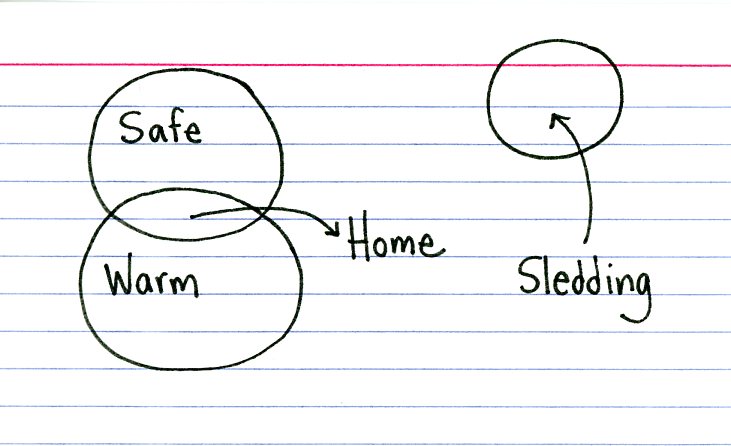
I really love the simple yet profound style of Indexed - mind beding simple "comics" (art pieces? visual haikus?) fitting in on a single index card, lines and all. They are all visualizations in the fullest meaning, either a line chart or overlapping circles.

Often, like in the sledding example embedded above, there is an implied X-Y scale to the circles as well - maybe comfort vs excitement  And with sledding just crossing the red line, into the "clear" field above you can read in a bit more even without reading the full tag line.

Or am I reading too much into two arrows, three circles, four words?

Wednesday, May 22

I love to hate my blogger

Well this was strange, and crappy.

What is that? An official blogger app for iOS. Updated May 6th 2013. Yay for list and status. Yay for edit. Nay for only bold/italic choices for formatting. Nay for no visible way of linking or editing existing links.

Considering that the web version doesn't work at all with chrome for iPad, I guess it is a small step up -  but compared to the Wordpress app it is scary bad. Proof that blogger isn't something google sees much value in, and that they have a hard time getting something decent together for tablets in general and iOS in particular.

Which like Reader seems strange to me, considering that they want to organize the worlds information, having it first hand would seem like a good choice? But I guess they crawl a lot better than they do UX, and probably more efficient all around.


But onto the quote and link for the post proper - another archived draft, this one from right after New Years, and related to dieting:
Controlling what you eat is an interesting challenge, but not nearly as important as controlling how you think.
[srcvia Seth's Blog

Reading bit by bit "this will make you smarter", a collection of short essays as answers, each about two full screens in the kindle app.

Quotes would go here.... On something more suited that a google product... Stay tuned (and yay for crappy html as well - total fail) 

I am my mind;

If you lead an organization, or have the sort of job that demands that you think about the world, these tools are like magic hammers. They will help you, now and through life, to see the world better, and to see your own biases more accurately.

Bias is one of the points brought forth, which ties into my other non-fic reading at the moment; Dan Ariely and a bundle of all three books. Considered jumping onto his Coursera offering, but the time just wasn't there, but finally reading all three books back to back is a good treat non the less.

Bias is the thumb that experience puts on the scale [ibid 1227]

Biases are there, we are wired into thinking some ways - but it is in part predictable, so we can, should, work with it. Not letting it go unnoticed in the autopilot lane, but taking a few minutes to reflect on why and how we assumed. Doesn't have to be a complete written expose, but checking yourself makes a lot of sense.

There is no absolute truth, since quantum states as we understand them contain probabilities all over the place. But also at a higher level, it is often more about storytelling than actual impact or 'fact'. A "causation web" rather than a pure and simple trigger for some thing, and then we try to influence various aspects of the web - based on what "makes sense" in our story, our reference frame.

Why do more than 40 percent of Americans think the universe began after the domestication of the dog? [ibid, 860]
Because it makes it easier overall? Religion puts things into place, makes for an overall narrative and guidelines that make a lot of sense.

Be nice, you will be rewarded, there is a Truth out there.

Does the timeline matter in the day to day life? Does it change how you would look at gas prices and environment? Taking something for granted or realizing that it is a (rather) finite resource built up over thousands of years, not likely to be around in the time of our grandkids?

But but but...

Think happy thoughts, it is a simple saying but a profound impact. How does it relate to bias? Is it the same thing, that we shape our world by our understanding and stories of it?

No, you can't heal yourself solely with (Jedi) mind tricks, but in a lot of situations your view impacts the process and the result in terms if how it makes you feel.

Energized or worn down.

Impossible or stretch.

 Same thing or not?


...and the sun washed out any hope of getting further for now - just as i realized that i've passed 500 published posts. it all adds up. given time, same as this post, third time the charm and out it goes on schedule in the morning...

Tuesday, May 21

wanting, needing, craving ...information is a goal


A piece on Nieman, a year ago more or less, but still as relevant. Three video lectures / talks, the first of which prompted the saving of the URL for a later day:
James Gleick ... bestseller, translated into 20 languages, is The Information: A History, a Theory, a Flood
Clocking in at 73 minutes, I have to admit that some of it has "flooded past" in the year gone by, but I still recommend it.

I group Gleick in with moderately large group of thinkers exploring the impacts of digital tech and content. Books like The Shallows, Hamlets Blackberry, Not a gadget and so on. And there is no doubt that digitization changes "everything". Would I have even heard about those books ten years ago before starting to blog? Maybe, but clearly not twenty years ago before seeing web and newsgroup content for the first time.

It is part magic, part wonderland 

- imagine that just about any speech or lecture can be preserved and shared globally. For no incremental cost on either end.

Rather than traveling to California I could sit on my couch, holding 10 inches of glass and watch the I/O keynote (first hour anyway...) along with A MILLION (!!!) other people. Working with thees kinds of things, it is useful to stop and reflect on just how far we've come every now and then. With hangouts on air and recording, you just need a webcam (built into any laptop and most mobiles) to invite the world in. Google handles the rest. Distribution, encoding, storage.

Just like that. 


Want to do a debate series, inviting two people from different countries each week? Just do it.
Want to do a class for school kids in your favorite subject? Press record.

Sure, there is something like a 100 hours of new content by the time you've finished reading this post. But that just means that the content that does resonate has the chance to spread that much faster, further and longer than before.


- ...and the sun is taking a short time out, so I can just about make out the text on the screen in my reflection .. brightness to the max, blogging from the balcony