Showing posts with label reader. Show all posts

Friday, June 21

Democracy, because you're worth it

"Democracy is the theory that the common people know what they want 

and deserve to get it good and hard."

via Quotes of the Day, one of many attributed to H. L. Mencken - listed as US editor (1880 - 1956) and it is the second to last of the draft backlog here. Fitting in a way.

It certainly reflects on thoughts going back to Plato and others, that the masses are more or less stupid, and giving them the full power will give them what they "deserve" rather than what they "need". Guidance rather than understanding being the defining bias. Some know better, and they should not only be elected, but preferred.

Democracy is not a single thing, and every nation that has at least one version running, does it differently. It is the ultimate open source forking model. Some states run things differently for different levels. Local, regional and national each having their rules and measures.

So it is a "broken" concept, yet it is vastly better than the alternatives seen so far. We can live with the small "injustices" of uneven representation or extended campaigning over political labour. And come fall here in Norway, the whole spectacle will get into gear. Because we deserve it. Because it is worth it.

Monday, June 17

Factual dreams - a true oxymoron


Sometimes it is easy to forget how "magical" current tech would seem to a visitor from the pas, or even ourselves enough years ago. 

Sitting here typing on a laptop with glowing keys so the light can be down and the sky outside can set the mood (scheduling pub time, summer dusk at present) 

With music coming down from the cloud, landing on my small slab of a mobile (or smart glass, or mini computer) and out via the connected speaker.

 Eva & The Heartmaker: Live fra Rockefeller http://wimp.no/album/20517767

And then glancing down at my e-paper watch to see the track title, and maybe skip or pause. 


In another ten or five years, the keyboard might be connected to the phone-slab as well, with the screen being multipurpose, rather than welded onto a battery and cd combo. Or the phone will be gone, replaced with a small biometric knob - able to connect to assets at home, at work and in the coffee shop.

Or not. It will change, but how it will transition is still thankfully unclear. We can dream, play, test and explore our way forward. Ipad,Air or MS Surface - will they become one or will all three have their niche? 

Why am I writing this on the big MBP, and not the iPad - or even over at the workhorse stationary pc? Full size keyboards on both, but the immediacy of the mid sized screen up close, as opposed to the vastness of the 24'' might be part of it. Or possibly the avoidance of distractions - games are lined up over there, a backlog of golden rpg games, bought digitally to fill in the gaps in the collection. Same goes for the iPad, the lack of full on keyboard (despite the nifty Touchfire needing some love) and an abundance of consummation apps makes other uses better than blogging. 

And still I lust for a brand new Air. Not because I need more gear. Nor because it is time to replace the latop. But because it is new. And shiny. And better than the one I lusted over last year. 
Solved it then by having a friend buy one with myself as advisor during the test and purchase. Not to mention rebooting the iPad2 for a forth gen. A cheap perk for my employer, considering the hours spent reading and staying up to date, on my own time. For now blaming the lack of instant OS update might be enough. Hassle free being a key decider in anything that will be just for fun and on my own time.

On that note it seems right to get around to the quote that started the tangent off:
This is the challenge of the Kickstarter artist, the growth stock CEO and the well-published author. Dreams are irresistible, but they will never match reality when it finally appears.
[seth G, my link added]

And that is why Kickstarter is the ultimate "weird" shopping experience - you get to play along with the process, so by the time you get the product you are vested, and using it feels a lot more natural than something you "just" bought in a store.

For some products the experience up to the product might be enough in and off itself. The feeling of being a patron of the (creative) arts making a transaction justified even if you don't really need the product that much.

Might also be why I had more or less shifted into digital only projects. Until a weak moment saw a dual dose of robots getting some support. So by xmas there should be a Sparky trotting along with some sort of BrickPI creation. Provided they both make it past customs and survive shipping.

Sunday, June 16

Think bad thoughts, it is worth it

Ending the weekend with a "live" post - more stream of consciousness than overly planned. The quotes were trimmed down a few days ago, so we'll see if it still makes sense now. More scheduled stuff coming in the next days, counting down towards zero in the backlog of drafts!

Started reading "Random Acts of Violence", about 1/3 of the way in, and it still is a bit unclear how to describe the book... it is sort of a typical "YA" diary, growing up story. But every few pages there are drops of something darker, more sinister in the background than just plain vanilla NYC.

But it none the less ties nicely into the post by C.S.Penn that initailly sparked the title;

An odd metaphysical thought (re)occurred to me last night while reading some of the day’s news stories. Maybe a contributing reason to why it feels like we’re experiencing more trouble in the world is because we’re actively wishing for it. [src]

Do we make the world we want? Or are we just flowing along in a comfort zone until it all breaks apart?

News and images coming in from Turkey over the last few weeks seem to enhance the "shit hits the fan" theory. Been there for vacation, and got more or less the same vibe as the majority of Mediterranean spots - secular, modern, a bit pushy and "fast and loose" with the stories.

Today the "official" protest is reported at a million in attendance... austerity in Greece, minor collaps in Cyprus and all out war in Syria. Now try sitting in the middle.

Our politics are more about putting the other guy/gal/party/ideology down than they are promoting what we believe in, so much so that we define candidates by what they oppose instead of what they support. [ibid]

Typically US? Or spreading a little bit every day? We are heading into election season in Norway, a slow simmer during the summer then some crazy weeks in early autumn. So far it looks like a lot of "name calling" dressed up as "taking a stand". On both sides. Both the incumbent coalition, and the opposition trying to figure out what kind of constellation they might win with and live with.

How will the overall tone be?

Last election was local, and came not to long after 227. So it was strange and respectful at the same time. This time it is national, and the stakes are higher than in a long time.

8 years of rule that has in most ways kept us out of the Housing/Euro/austerity crisis rolling across Southern Europe and the US.

But how much would really change? In the largest city in southern Norway, the two main opposing parties ruled together last term - because they both had issues with their respective coalition partners. And the direct changes in the budget (ie above and beyond the running costs and long term agreements) is tiny.

If a company or organization does something good, does something constructive, then reward them with your business. Be especially vigilant about rewarding people of opposing viewpoints when they do something that’s good – recognize that even in your differences, we all share the same common hopes and dreams. [ibid]

So play nice, reward nice - and think about the choices you do make - be it of action or omission


The post How to starve trouble appeared first on Christopher S. Penn : Awaken Your Superhero - read it in full there!

Friday, June 14

Share a way, then I can find my way

[chris brogan] did a post called "Owners start with recipes";

I’ve made a mistake over and over again. I continue to believe that we don’t want recipes, that we don’t want leaders. But neither are true.
[...] If I don’t show you what I know, and if I don’t show you how to cook a “something,” you might not feel confident enough to first replicate that something, and then vary and create your own magical dish.
It feels so right when you read it like that.

Not everybody is an explorer.

We can't all make our own MVC javascript framework (or we shouldn't - but that's for another rant)

But at least some thing are better off with a bit of guidance.

I had played around with d3 a bit - but it was only with Scott Murray's brilliant book that I both sat down for some extended time - and got a lot of ideas for minor tweaks, and then put some into the wild, and got more ideas by seeing other projects. All because I knew I had the "basics" in hand should I need to reboot.

The book is both a contained entity, promising that you can get through it and on to your own playtime, and a natural progression - chapters and pages flow from the barest basics to fully working and useful examples

Also probably why business books will continue to sell well - there is always a need for some handholding, just getting a consistent story and a feeling of "overview".

Not to mention consulting. Having someone who tells you that "this is the way it is done in business A and market B" makes for a good starting point.

But for both books and consulting, the difference between wasted time and world class can be hard to spot - since it depends a lot on your own situation and level;

- how far along are you on your journey from reading the FAQ to writing it?

Thursday, June 13

Some lines are there to cross, others to sharpen the image


The power of zero spend [src];
Rigidity is rarely your friend, but well understood boundaries make decision making a lot easier.
Two Seth quotes almost back to back, but they are from months apart initially. This also marks a push of the draft box into single digits. And that is a nice simile here - having pushed a lot of links partially out by lack of proper draft API, it was time to clean up the blog. Doing that by focusing on getting out at least 5 posts each week, and mainly by eliminating the backlog has made for a bit of extra structure and push.

Same goes for getting a project off the ground - set some (arbitrary) ground rules;

  • we'll be testing 3 ideas at a time, but revise that to 2 if the differences are large enough during first runs
  • each period will be more or less a week, so we have time to get data, make new ideas and run the numbers
  • keep the numbers simple, and consistent - do initial comparison within each test, then combine and compare after 3-4 runs
SImple steps, but makes the difference between going all ad hoc, and being to rigid to flex out the time. 

Had a similar experience in terms of design constraints - a subcontractor just blew past the boxes that had been set up. But the end result was so much better, and inline with the actual goals (rather than the guides), that is will serve as a new template - at least for now.

Some boxes you play nice with, others you just rip apart, and use the shreds to pave a path forward.

But how do you figure out ahead of time which kind of box you are in?

Tuesday, June 11

i'm not young enough to know everything

- that's an Oscar Wilde quote taking the place of the title, having just heard it on Podcastle as I jumped off to get some thoughts in line here. Just realized the backlog and schedule was all out of content. But there are still a handfull of drafts to go - and then Pocket is filling up with good ideas and inspiration, so it looks like 2012 will be passed in terms of actual posts by the end of June.

Summer is a time of long afternoons stretching right into the night - half an hour to go for midnight, and still pretty light outside, a grey and rosy tint to the clouds. It is also a time for more reading of books on the Kindle in the sun, than skimming twitter and the web on an active screen like the ipad or laptop.

That might be why this quote is so suitable, from yet another Seth Godin post;
If you're upset that the hoi polloi are busy doing what you used to do, get better instead of getting angry.

Sure, you might feel entitled because you spent a lot of time (and perhaps a bit of effort) learning or getting access to things that were special - publishing a book, writing for a paper, designing visual or actual stuff - the list goes on. But now "everybody" can do it.

Doesn't mean they are going to be good at it.
Nor that they will be able to charge for it.

But it does mean that your nice little superior niche is busted wide open.
For some areas it means a lot more business - how many people make a living brewing coffee today?

For others it means a changing relation - being a wedding photographer amidst instagram and vine means you have to bring something more to the shoot, be it composition, scope or storytelling.

Just do it? Smarter, not harder.

Sunday, June 9

Who's your master?


Been thinking about this post on and off for some time - partially based on the post [six pixels - Mitch Joel] - but also as I attended a "MOOC" on the Functional Art by Alberto Cairo, via Knight.

With so much information and insights all around, how do we best structure and create learning for ourselves and our peers?

Reading books, blogs, reflecting on them both in posts of our own.

Are blog posts the natural next level for term papers and other more scholarly deliverables? When we can discuss in forums online, do we need in class interaction - at all or for the same things?

In a single post you can explore an idea. Then across a series of posts you can start to get a grip on a topic. You can discuss quotes and include video snippets to set the stage for those reading at a later time, or simply to make the points more clearly.

You can edit. Sometimes almost to easily and carelessly. Wikipedia handles this by having the story right there, and WP3.6 is supposedly revamping the versions.

But can we all just choose and pick? Or are the ones who are able to just grab some books, read some articles and then just do it - the odd ones out?

How many of us are curios and driven, for how long? Is it school that "destroys" the lust for learning, the exploration and playfulness? Or is it something more at the core of each of us? Are we blaming the nearest and only common cause, rather than looking inside? Is it "the resistance" that drives us to prefer shelter and structure over "snacking" and exploration?


I'll let Mitch close this one out - not with his "punchline", but with the part that resonated the most for me:
Do not wait for a course to give you the answers. The answers are everywhere. Dive in. Be curious. Show up. Be serious. Be passionate. Be open.


Saturday, June 8

taxi, taxi driver - drive me a story tonight

Replaying A Night in the Life of a Cabbie
The result - a "moving" piece
Sometimes the simplest question begets the most amazing results. And this interactive represents one of those cases.

The background (as retold to / on Source) was simple enough, but represents a novel twist on the "and why should I care" conundrum;
My goal was to give the reader the experience of being down $120 and needing to earn that money back

How do you do that? Well, step by step is a nice starting point - and having a "running" meter beneth the map is a great way to connect the real world taxi with the visuals in the story
     var line = new Polyline();
        requestAnimationFrame(function() {
          var point = getNextPoint();
          line.addPoint(point);
        });


And here-in lies the beauty of the simple done good enough:
Speaking of judgment: this code is super duper non-optimized. It could be several orders of magnitude faster by throwing in some clever tricks and caches. But the fact is it works, and it works across platforms. That’s the most important requirement you face in a newsroom!
Everything could be made better, re-factored  generalized. But often times having that luxury would take time away from the functionality at hand. Just like a piece of journalism generally reads differently from a novel, and a studio produced movie looks better than a snap of a goal in a football match. Given the right time and resources everything can be polished, but often good is good enough. And something new every day is even better.

[src, via Source]


Wednesday, June 5

I want to do it all, and then some more


How do you decide?


Chances are there are more thing you want to do, than people to do it.
More ideas than project teams.
More bugs than developers, never mind testers.

Should you focus on those big things that "wake up the neighbors" - attract a lot of attention and flair, preferably within the niche or market you play in - or should you do a lot of smaller, unknown and unknowing tests? Build the future stepwise, or stay the course first and foremost?

How do we find a balance? 

Can we?
Should we even try?

One reason that incumbents are so often defeated by newcomers is that the incumbents put their best people and their urgent focus on the stuff they used to do (like winning Pulitzer prizes, selling ads to cosmetic companies and counting dead trees) while the new guys have nothing but the new thing to focus on.
[seth, who else?]


Are you doing it wrong if you do what you know, what makes sense right now, and what "everybody" else is doing? Is radicall innovation and transformation advisable, never mind possible? Is it right to say to your current customers "sorry, we want someone else, so you'll be getting an inferior product - but it will be a lot better in a while, albeit something completely different"?

Apple could do the iPhone because they didn't have a phone business, didn't have telco relations to maintain, and an upgrade path to stick to. 3g, 4, 4s, 5? Incremental wrapping and icing on the cake.

Apple could also do the iPad, because they had 10% or less market share for laptops. Microsoft couldn't for the same reason. They had too many partners to placate, making the assorted touch screen laptops never-rans.

Facebook bought Instagram. Even if they had the bigger volume of users. Even if they had apps and were THE photo destination. But they didn't have or get mobile. As a core. As the only thing. Do they now? At least a bit more than before the 1 bn.

Just right, just so?


Tuesday, June 4

Not what I expected - but summer reading


But it is what it is. And this image from [Indexed] - posted on xmas - makes for a good reminder.

The tagline for the post was "may you live in interesting times" - so a natural summer reading recommendation would be:

Interesting Times - discworld novel #17, a bit of travel, some intrigue and politics, but most of all a great read.

I just finished novel #38 -Unseen Academicals, a great riff on sports, crowds and dreams, so I'm a bit fuzzy on the details for I.T - having read it back in '97 or '98 - but seem to recall it being a bit free standning, in that Rincewind takes a trip to the Counterweight Continent, making it both a jumping on point for new readers (where have you been hiding? 70 million books sold or so? Get with the program!) and a change of pace from the more connected story lines involving the Watch and the Witches.

For a full overview of the Discworld books and their internal principal connections, the LSpace has a "map".

And for some colorful background on the quote or curse, Wikipedia has the goods.

Monday, June 3

Give me an L, an O, N


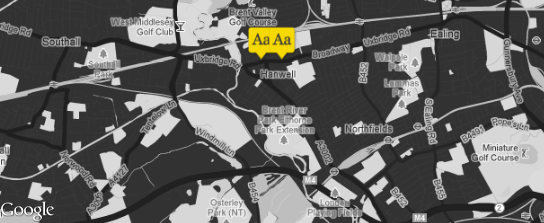
Map of the Week: London Typographica showcases crowdsourced images of lettering and typefaces around London. It uses styled maps to both provide a clean background to display their markers and to allow people to navigate to areas they may want to explore.
[src]

via Google Geo Developers Blog - love the concept, and the execution of the map itself. Also a big up for having made an app for gathering the images directly with geocoding included. They have even made two different styles for the map, overriding the default google zoom detail levels.

What i miss as a user is some sort of guidance - a path or five through all the images.

  • How do I find all the A's?
  • Where are all the serifs? 
  • The block fonts? 
  • The signs rather than the street art?
Apparently, there is something in the works - or at least the idea is there - one image had this;

Tags: lettering, caps


So, I'll check back in another couple of months (GGDB post from Dec-12), and keep playing with my little statue location info app.

Sunday, June 2

Consistency is a drag

"This is the best I can do" vs. "It's not good enough."
[seth]

Yes, it is another Seth Godin quote, there were a few in the draft backlog - deservedly so. Topic is failure to launch, innovate, improve and otherwise change.

For some it is due to a complacency - "if it ain't broke" type mentality. Change is hard and painful  Launching is scary. So it is a lot better to stick to the course, keep churning out the widgets / 30 second spots / 300 word pieces. We lull ourselves into thinking that we have tried and discussed other ways, but this is the best for the time we are in in, the people we have, the customers we serve.

For others it is due to perfection - it could be a bit better, the design needs some work, we have to get another blurb, run another focus group, wait for a better window, avoid this week, don't compete with that event. When there is no deadline, it is all to easy to let it be dead on the line instead.

The way to improve, is to change. And to change we have to get feedback. And to get feedback? Launch. Get it out there. Call it a beta or a soft launch, but get it out the door.


one caveat; make sure you set aside time to listen, evaluate and then re-launch or re-boot.

Saturday, June 1

Summer reading - comic; Looking for Group

That’s right boys and girls, we are pleased to announce that LFG Volume 5 (in beautiful hardcover action) is now available for pre-order.
For the last books (vol 3 and 4) I re-read the previous collections before diving in. This time I've just left it a bit to really enjoy it during what will hopefully be some leisurely summer days. Have pre-ordered all five as they became available, so a signed collection

If you are new to Looking For Group, it is a webcomic, available to read for free - or you can pick up an omnibus edition for a mere $40 and support the artists. It is an epic fantasy comedy / parody / slightly twisted telling - and often "laugh out loud" funny, in a literal sense, not just LOL tweet.

Thursday, May 30

...and I'll be forced to tell you no lies

Picking up the thread from last post on "lies to children";
People mean well, especially friends and family, but they're going to give you bad advice. ... PS the irony of this post is not lost on me.
As often a great mind-bender from Seths blog - how he gives advice about people giving bad advice.

There is something so simple about it, how most advice is in a way bad, because we can only ever give advice based on our own understanding, and not the 'real' situation. Nor can we (most of the time) decipher and understand the drivers for someone else, really see where they want to go, who they want to be.

And thus, our advice is more or less a story about how we think the situation should be handled to reach the resolution that fits our narrative - not necessarily for ourselves, but our narrative of the current and future state of whomever we are talking to.

Does that mean we shouldn't give, or ask, advice?

Or just that when we decide what to do, advice and "seven ways of" or "top ten tips" should be a set of inputs to calibrate our path?

I'm certainly not telling...

Wednesday, May 29

Ask me no questions

Feynman recounted another good one upperclassmen would use on freshmen physics students: When you look at words in a mirror, how come they're reversed left to right but not top to bottom? What's special about the horizontal axis?
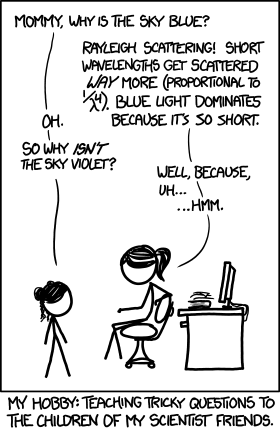
xkcd - Sky Color
A quick note, the xkcd strip on the left [src] reminds me of one of the underlying premises in the Science of Discworld books, "lies to children".

How we often make narratives more important than the actual facts, so as to make it easier to understand, remember and repeat.

And in part how even those who "get" a field have a hard time explaining it in terms that a kid can relate to.

The devils in the details - like the human body being at the same time 70% water, and 90% microbes...


Sunday, May 26

Stop paying attention

(c) Dilbert - Scott Adams 


[Dilbert]
Is a nice way to round of this batch of posts - and for the schedule to round off the week with it.

Do you ask "what is less important" every time some one comes and says "this is urgent"? 

Not the best way to get a rep for being a team player. But certainly a good way to remind people that there is very little slack built into any company or position in 2013.

If something new comes along, it needs to be instead of, not in addition to. At least for a given unit of time.

Thankfully digital tools like Trello makes it easy to show the assorted lists of priorities, and swap things around (with a note saying why).

So how is the week ahead stacked up? 110% load and a backlog until Xmas?

Saturday, May 25

Data viz - it is taking shape

A summary of the post "A Conversation with Data Visualization Experts" - simply the subheadings, as a jumping off point (and not intended a full repost as IFTTT did - the risks of automation!)

  • Which came first, the question or the data set?
  • Visualization as tool vs. visualization as art
  • Data visualization is an iterative process; seek feedback
  • The right tools for the job
  • Good questions, iteration, and feedback

Bostock confirmed that his team at the Times does this as well, using a git repository to track all of the iterations the visualization has been through…sometimes as many as 250 changes to a single piece. 

Love the idea of using git to track iterations during testing and ideation - that way you also have a backlog to play around with next time a similar dataset or question comes up. Been using svn and saving major iterations (ie when something works...) but taking it a step further makes sense. Just need to automate and simplify the flow a bit more than "right click, type, enter, close"

Then onto the ideas or discussion points themselves;

It seems that some of the better works come from the question "how can we do this differently" - taking a trope to the next level, like the 512 paths interactive. That piece is a functional artwork (ht A. Cairo) - it is great to look at even before you dig into the options and understand the underlying data. But it is most of all a storytelling tool - because all the paths were not created equal, and that (in my mind) was the main point of the story. You could dream up all possible iterations, but only a very limited set lead to something other than the actual outcome.

The time to iterate, and getting the culture in place for it seems like one of the most challenging parts of getting data viz going. At least in a smaller organization where there isn't room for a dedicated team, you need to get people comfortable doing a crit on something they don't really understand how came together. In that sense D3 is a great tool, because it is relatively easy to "live change" a sample; 
  • Could it be green to pink? Swap the colors, reload and discuss. 
  • How about bar vs column? Swap X and Y and you'll have an idea at least. 


And now with tools like Vega and the playground you can do a bit of up-front mocking in minutes. Personally I still love doing ideas on a whiteboard, but it does take a bit of 'translation' to get new people up to speed - that's where a digital first makes more sense.

Friday, May 24

Inspiration makes the future something worth waiting for

"...and you’re off to the manufactured normalcy races, where nobody wins because everyone goes to fucking sleep."
  W. Ellis 

Quote from a keynote he did in September 2012. So we are already in the future, looking back and forward again. Would have loved to seen it as a video, but well worth reading in full.

The main takeaway (for me) is about how we need ideas to push us to make reality. Slapping a Hello Kitty case on a phone isn't innovation. But making a phone so slimmed down it almost NEEDS a case to protect it is.

It is the wild ideas and visions from art, books, movies that push us to try to make a different tomorrow.

Kevin Kelly touched upon a similar vibe in the 20 years celebration issue of Wired, it is about spreading ideas and opportunity out globally, at scale. Change the world one byte at a time. And if you can envision a better tomorrow, then somebody else is probably impatient enough to try to make it next week rather than next year.

The same idea was a foundation for the Ridley Scott show "Prophets of Science Ficiton" on Science, covering greats like Jules Verne, Asimov, Heinlein, Clark. How reading their books prompted a lot of people to not only study science, but try to make it a reality. And preferably before someone else did it. Not enough to get to the Moon, it has to be first, fastest, longest.


Because, if we settle for JUST pushing the button 3px to the left, we risk loosing that drive, the competition and the dream of a new tomorrow.

Thursday, May 23

Can't have it both ways, so get to it

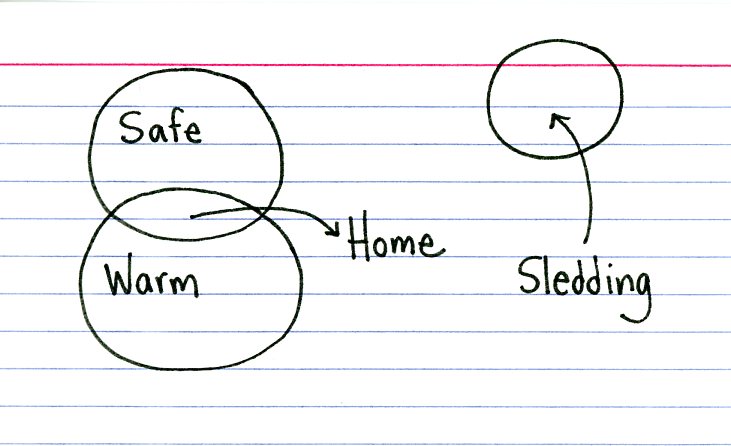
Go back up the hill, kid.


[src] - via Indexed

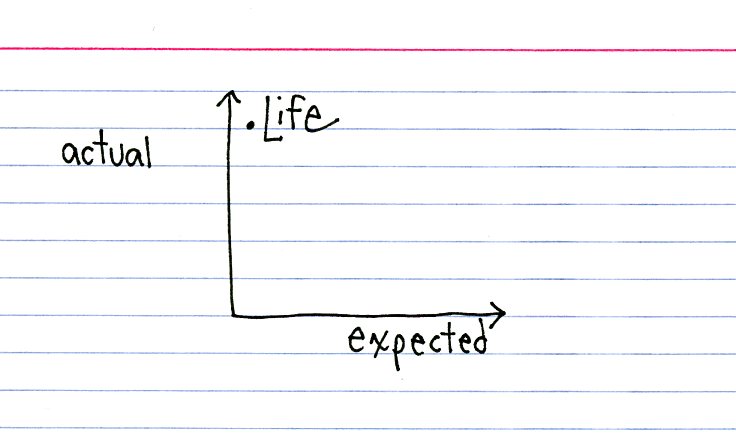
I really love the simple yet profound style of Indexed - mind beding simple "comics" (art pieces? visual haikus?) fitting in on a single index card, lines and all. They are all visualizations in the fullest meaning, either a line chart or overlapping circles.

Often, like in the sledding example embedded above, there is an implied X-Y scale to the circles as well - maybe comfort vs excitement  And with sledding just crossing the red line, into the "clear" field above you can read in a bit more even without reading the full tag line.

Or am I reading too much into two arrows, three circles, four words?

Wednesday, May 22

I love to hate my blogger

Well this was strange, and crappy.

What is that? An official blogger app for iOS. Updated May 6th 2013. Yay for list and status. Yay for edit. Nay for only bold/italic choices for formatting. Nay for no visible way of linking or editing existing links.

Considering that the web version doesn't work at all with chrome for iPad, I guess it is a small step up -  but compared to the Wordpress app it is scary bad. Proof that blogger isn't something google sees much value in, and that they have a hard time getting something decent together for tablets in general and iOS in particular.

Which like Reader seems strange to me, considering that they want to organize the worlds information, having it first hand would seem like a good choice? But I guess they crawl a lot better than they do UX, and probably more efficient all around.


But onto the quote and link for the post proper - another archived draft, this one from right after New Years, and related to dieting:
Controlling what you eat is an interesting challenge, but not nearly as important as controlling how you think.
[src] via Seth's Blog

Reading bit by bit "this will make you smarter", a collection of short essays as answers, each about two full screens in the kindle app.

Quotes would go here.... On something more suited that a google product... Stay tuned (and yay for crappy html as well - total fail) 

I am my mind;

If you lead an organization, or have the sort of job that demands that you think about the world, these tools are like magic hammers. They will help you, now and through life, to see the world better, and to see your own biases more accurately.

Bias is one of the points brought forth, which ties into my other non-fic reading at the moment; Dan Ariely and a bundle of all three books. Considered jumping onto his Coursera offering, but the time just wasn't there, but finally reading all three books back to back is a good treat non the less.

Bias is the thumb that experience puts on the scale [ibid 1227]

Biases are there, we are wired into thinking some ways - but it is in part predictable, so we can, should, work with it. Not letting it go unnoticed in the autopilot lane, but taking a few minutes to reflect on why and how we assumed. Doesn't have to be a complete written expose, but checking yourself makes a lot of sense.

There is no absolute truth, since quantum states as we understand them contain probabilities all over the place. But also at a higher level, it is often more about storytelling than actual impact or 'fact'. A "causation web" rather than a pure and simple trigger for some thing, and then we try to influence various aspects of the web - based on what "makes sense" in our story, our reference frame.

Why do more than 40 percent of Americans think the universe began after the domestication of the dog? [ibid, 860]
Because it makes it easier overall? Religion puts things into place, makes for an overall narrative and guidelines that make a lot of sense.

Be nice, you will be rewarded, there is a Truth out there.

Does the timeline matter in the day to day life? Does it change how you would look at gas prices and environment? Taking something for granted or realizing that it is a (rather) finite resource built up over thousands of years, not likely to be around in the time of our grandkids?

But but but...

Think happy thoughts, it is a simple saying but a profound impact. How does it relate to bias? Is it the same thing, that we shape our world by our understanding and stories of it?

No, you can't heal yourself solely with (Jedi) mind tricks, but in a lot of situations your view impacts the process and the result in terms if how it makes you feel.

Energized or worn down.

Impossible or stretch.

 Same thing or not?


...and the sun washed out any hope of getting further for now - just as i realized that i've passed 500 published posts. it all adds up. given time, same as this post, third time the charm and out it goes on schedule in the morning...