Showing posts with label art. Show all posts

Tuesday, August 13

imagine images everyday

I currently have some 200 images on my phone. That I have yet to sync, duplicate and sort on the laptop. That is just from a short period of time, and I've deleted a bunch along the way as well - keeping only those that are good enough.

Back when using film it was 24 at a time. Maybe for some trips you would do two or three rolls. Now that is a trip to the playground, or a long walk when the weather has changed. 

Just knowing they are there, that I can have a look is (so far) more rewarding than looking at a lot of them. They are a gift to my future self. For remembering days, weeks and months now gone. For inspiration, and joy. And for limited curation, in terms of prints, books and magnets.

The reading that inspired this little tangent on volume and remembrance by camera;
"All of this is closer to the now than to the future. We've already seen tagged photos streaming forth from a billion networked smartphones, broadcasting the Arab Spring to Twitter and police brutality at Occupy to YouTube."
[clayton cubitt  blog post - on the constant moment]

How will you deal with everything seen being stored? 
What could you do with it? Make art? Explore your life?


- ...and the sun was here every day in July - bringing monthly rainfall below 10% of normal... but as we entered August the backlog came back, and so did the scheduled buffer for a bit - 

Friday, August 9

Make mistakes. All the time.


Quote and image from Chris Brogan this time around - on the willingness to be wrong;
"The amount of mental energy we expend by trying to be right all the time is a waste. I have come to learn that it’s a lot easier to be wrong from time to time, and that the process of being wrong can certainly speed up the finding of what it is that ends up being right."
[Be Willing to Be Wrong]

Part of a recurring theme here - failure is not a bad thing. Failure is bad if you don't use it for something. And it is better to "fail fast", than to drag your feet - or keep pouring resources onto sunk costs.

As long as you are open about it in the process as well; our best estimate is that.... based on what we can find today it .....

Decide how much time you have to make sure, then use your best judgement, launch, measure, change and do it again.

Don't go for perfect track records.
Go for always trying.
And always improving - if only by a little bit each time. It adds up.

Monday, August 5

Too good to fail?

Kicking off the week, and starting the autumn season with some thoughts on this piece by Seth on competence as a barrier to possibility. Basically considering that when we get good at something, we know how it is done and what the result should look like.

And just maybe because of that, it is easy to loose sight of the possibility of "creative mutation" or "successful failure"

Just like automation takes out the "handmade" feel in products?

Jaime Oliver used to say that he intentionally cut pieces at odd angles and assorted widths, just to retain that feeling of a personal touch. Smashing up the onions and the mushrooms a bit, so it looked like "real" pieces, rather than machine processed goods.

How easy is it to use an error as something to build on, rather than just something to be pruned out with out further consideration?

Chances are, if something is a bit off, it might trigger ideas that then lead to further changes and explorations.

But they could also just lead you on a tangent. So setting aside some time, rather than doing it every time is a good idea

Sunday, July 21

tsundoku, not just sudoku


Wow, the Japanese have a word for "the act of buying books and not reading them, leaving them to pile up": tsundoku 

Wondering if it applies to dvd and games as well?

Or if they have separate terms for the assorted forms of lacking consumption despite the desire.

The backlog is pretty stuck, at least not buying any new stuff. Mostly. Physically.

Got close to half a shelf full of fun stuff from Amazon, mainly photo and drawing or animation related. The stuff that isn't just about reading, but needs some doing as well. Aspirational, more than pratical plans.

Regular books are only Terry Pratchett. And with his health I've been holding off a bit on reading the latest books. Just in case. And despite some splurge shopping the Kindle reading list is in pretty good shape.

Then there are the iBooks shelves - running up a technical backlog, mainly things that are somewhat tangential to "business as usual", since 50% deals at O'reilly are to frequent and to much fun. Daily deals and then some.

Then there was that batch of games during the GOG drm free weekend sale. ONly 15-20 titles depending on how you count expansions. Does that count? Actually considered buying some games on dvd rather than there, since summer sales are in effect other places as well.

...and then there is that 2 month free trial of Comoyo video I've been meaning to get started with. Free. No strings attached.

...and also really should get on Netflix soon, rewatch House of Cards, and some series - but they don't have Sopranos or Wire, so getting a binge on for those will need another solution, like testing out HBO.


How many #backlogs do you have taking up space or mental effort?


Is it a problem, or a pure luxury?


wondering a bit about Google - midway through writing I was "logged out somewhere else", and asked if I wanted to log in again... no, no, just in the middle of typing a sentence, no need to do anything else. 

Wednesday, July 3

Twisted tales of Buffy meets Donnie


This is not a review, but some musings that I wrote down after watching Southland tales - definetly on my top ten mental movies list. But still a must see. In a way. 

IMDB says people who liked it also liked Brazil and Bladerunner. Which makes a twisted kind of sense. My summary is simple;

Tuesday, June 25

Better to have than never?


Just a short post, going out directly not from a draft but from a too long open tab, as summer vacation takes it toll on the posting streak;


Now or never, now or never, now or never—the words niggled at me like a song stuck in my head.
The quote is from the intro to the story in PodCastle 219: The Circle Harp - and you can listen in full, for free as with all the goodness from Escape Artists. The theme is about taking a chance or sticking to what you know.

At what point will it be better to go for something "a bit over the moon", rather than playing in the same small pond? Is it better to lose in the big leagues, than to dominate in the minors?

Can you develop your art without stretching beyond the comfort zone? Do we need to push it into the next gear? Or is there a place for doing it good enough, providing what is needed and valued by the audience we have? Trade off or cop out?

- ...and the sun is promising a warm wonderful day of summer, and 7 new drafts made it into the backlog via ifttt ...

Saturday, June 15

It's all about the execution, stupid

Not really, since Strategy matters more than ever:
When everyone is playing the same game, your execution is critical. [...] Not changing your strategy merely because you're used to the one you have now is a lousy strategy.
Yup, Seth again, this one from July 23, 2012 - such a treasure trove. The gift that keeps on giving.

Does digital open up for more copycats, or does it force us into our own path and localized maximum?

There are probably more Groupon clones, than there are active users of coupon services. But there are still more other start ups playing in the distribution, rewards and benefits arena. And as the different ideas gain traction, it makes a lot more sense to do it differently, rather than trying to "out Amazon Amazon"

Not even sure if Google or Microsoft* can do that in terms of cloud offerings - AWS is THE dog, it plays for scale and pushing costs to zero. Having services like Netflix does a bit for your volume and requirements.

Same way YouTube totally dominates in video hosting, distribution, monetization and partially creation. Pushing the scope ever outwards, doing hangouts on air, paid channels, longer clips, higher quality. Step by step eating up the niches. Vimeo made sense in a more constrained time for the "above average" video producer, but now?  

The same digital flexibility is what you need to play around with, map out not THE path, but a set of options, interconnected or related, and figure out how you might need to pivot up front. Just like playing chess - if competitor X launches this, we'll do ..., but if competitor Y appears, we'll just ...


Run the scenarios. Describe the story. Map the future. 

Rinse, repeat. Because in 6 months there will be new players, models and options.


* love how the blogger dictionary doesn't see the need to capitalize Blogger or Google, but microsoft gets a red line

-...and the sun has been staying around in the early days of June, here's to hoping for many more lazy days and late warm nights...

Friday, June 14

Share a way, then I can find my way

[chris brogan] did a post called "Owners start with recipes";

I’ve made a mistake over and over again. I continue to believe that we don’t want recipes, that we don’t want leaders. But neither are true.
[...] If I don’t show you what I know, and if I don’t show you how to cook a “something,” you might not feel confident enough to first replicate that something, and then vary and create your own magical dish.
It feels so right when you read it like that.

Not everybody is an explorer.

We can't all make our own MVC javascript framework (or we shouldn't - but that's for another rant)

But at least some thing are better off with a bit of guidance.

I had played around with d3 a bit - but it was only with Scott Murray's brilliant book that I both sat down for some extended time - and got a lot of ideas for minor tweaks, and then put some into the wild, and got more ideas by seeing other projects. All because I knew I had the "basics" in hand should I need to reboot.

The book is both a contained entity, promising that you can get through it and on to your own playtime, and a natural progression - chapters and pages flow from the barest basics to fully working and useful examples

Also probably why business books will continue to sell well - there is always a need for some handholding, just getting a consistent story and a feeling of "overview".

Not to mention consulting. Having someone who tells you that "this is the way it is done in business A and market B" makes for a good starting point.

But for both books and consulting, the difference between wasted time and world class can be hard to spot - since it depends a lot on your own situation and level;

- how far along are you on your journey from reading the FAQ to writing it?

Monday, May 27

Quality of Zen

In some ways this is the third post in the 'reading' series, but since I'm skipping to the end of Part II for this one, I'll try to add it into the flow later when the gap is closed. That is, covering the parts from around location 900 up to 3000 - and seeing how much still makes sense, in so far as the book makes any sense in and of itself.

So, close to the end of part II - we are back at the old school, revisiting the forgotten past - and having memories come back, along with some of the core ideas;

"What is quality in thought and statement?”

Quality…you know what it is, yet you don’t know what it is. But that’s self-contradictory. But some things are better than others, that is, they have more quality. But when you try to say what the quality is, apart from the things that have it, it all goes poof! There’s nothing to talk about. But if you can’t say what Quality is, how do you know what it is, or how do you know that it even exists? If no one knows what it is, then for all practical purposes it doesn’t exist at all. But for all practical purposes it really does exist. Location 3003

Quality is intangible  it is not something we can easily measure - although many characteristics related to, or derived from quality can. Durability. Workmanship - as a lack of errors, a precision in production and an adherence to spec. Yet so dominating and impactfull a concept. 

Quality is how we define and refine our positions. We like to think we make good choices. And by extension  think that quality is what we prefer. But why do we prefer it- for any given value of it? Is it the sum of the parts, the overall feeling, the little details? 

How has branding taken over the role of quality and entertainment the role of reflection? 

Brands were in parts created when we stopped buying direct. When we didn't any longer have a face to face relationship with the man who made our candle, we had need of a way to differentiate and remember. Both as seller and buyer. 

But now? 

When it is the same factories, using many of the same components that make our gear? Can you brand a pure experience, like using software? Or does it take a product you can hold and compare?  This could be why the iOS volume has been so great compared to previous pc/laptop. The touch experience makes the app and the content tangible in a different way. Makes it yours, even if it is shared by millions. 

How many people used to created, in the age of radio? And the early days of television, was it overflowing with people filming their own shows? No, the dream of a participatory society is probably just that. "Most people" don't discuss politics, but how their team did and how dinner tasted - not the ecological impact of using that brand of beef.

By that extension, is price an indicator [of quality] or simply a rationalization to signal intent and aspiration in a broader context? Most books cost the same, and seeing one movie over another isn't likely to get you a discount. But in subtle ways there is a price indication in play. Watching TV at home is cheaper than going to the movies, which is again outpaced by seeing a play. 


- ...and the sun brought me out, and the idea drove me inside, for it was one of those times...
[soundtrack: Volta - by Bjørk, faded down to set or keep the mood]

Saturday, May 25

Data viz - it is taking shape

A summary of the post "A Conversation with Data Visualization Experts" - simply the subheadings, as a jumping off point (and not intended a full repost as IFTTT did - the risks of automation!)

  • Which came first, the question or the data set?
  • Visualization as tool vs. visualization as art
  • Data visualization is an iterative process; seek feedback
  • The right tools for the job
  • Good questions, iteration, and feedback

Bostock confirmed that his team at the Times does this as well, using a git repository to track all of the iterations the visualization has been through…sometimes as many as 250 changes to a single piece. 

Love the idea of using git to track iterations during testing and ideation - that way you also have a backlog to play around with next time a similar dataset or question comes up. Been using svn and saving major iterations (ie when something works...) but taking it a step further makes sense. Just need to automate and simplify the flow a bit more than "right click, type, enter, close"

Then onto the ideas or discussion points themselves;

It seems that some of the better works come from the question "how can we do this differently" - taking a trope to the next level, like the 512 paths interactive. That piece is a functional artwork (ht A. Cairo) - it is great to look at even before you dig into the options and understand the underlying data. But it is most of all a storytelling tool - because all the paths were not created equal, and that (in my mind) was the main point of the story. You could dream up all possible iterations, but only a very limited set lead to something other than the actual outcome.

The time to iterate, and getting the culture in place for it seems like one of the most challenging parts of getting data viz going. At least in a smaller organization where there isn't room for a dedicated team, you need to get people comfortable doing a crit on something they don't really understand how came together. In that sense D3 is a great tool, because it is relatively easy to "live change" a sample; 
  • Could it be green to pink? Swap the colors, reload and discuss. 
  • How about bar vs column? Swap X and Y and you'll have an idea at least. 


And now with tools like Vega and the playground you can do a bit of up-front mocking in minutes. Personally I still love doing ideas on a whiteboard, but it does take a bit of 'translation' to get new people up to speed - that's where a digital first makes more sense.

Thursday, May 23

Can't have it both ways, so get to it

Go back up the hill, kid.


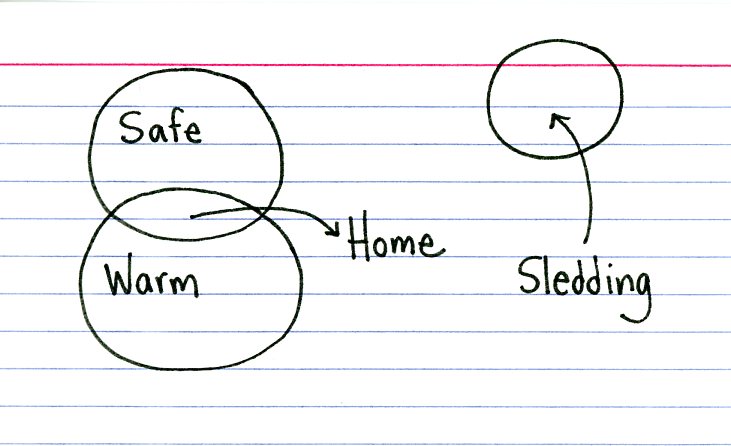
[src] - via Indexed

I really love the simple yet profound style of Indexed - mind beding simple "comics" (art pieces? visual haikus?) fitting in on a single index card, lines and all. They are all visualizations in the fullest meaning, either a line chart or overlapping circles.

Often, like in the sledding example embedded above, there is an implied X-Y scale to the circles as well - maybe comfort vs excitement  And with sledding just crossing the red line, into the "clear" field above you can read in a bit more even without reading the full tag line.

Or am I reading too much into two arrows, three circles, four words?

Sunday, May 12

Another verb in the stairs

@osol: "Increasing the knowledge and vocabulary of a child before age 6 is the single highest correlate with later success."
https://twitter.com/osol/status/255925136400719873

Guessing still no twitter cards in blogger?

Oh well, is is a quotes from NYT - in a piece on the challenges of teaching, and it links onwards to a review by E. D. Hirsch of the book "How Children Succeed" (kindle) which is still creeping up towards the top of my 'soon to read' wishlist in Amazon. 

But the point is well made, building both vocabulary, reading skills - and interests at an early age is seen as a boost up, starting the "race" already at speed rather than from a standstill.

Looking at the "most sold" lists in the iPad Appstore I wonder how this will play out over the next years. 
The top ten paid apps are more and more often keyed towards kids edutainment and learning. Estimates put the number of tablets sold in Norway last year at around 500k - that is one for every four households. And expected growth of 50% in 2013, so an additional 750k.

Does that mean that "everybody" is getting a tablet, or that some households have two or more? Most likely the latter. And add in willingness to pay for apps, and the time to use them with the kids, and we are talking about a possible gap of basic skills going into the first year at school. This is the digital divide. Or?


Sidenote;
Considering how much effort Amazon is apparently putting into "big data" and predictions, i'm amazed at how little weight the wish list feature is given. I buy probably around 70% of my reading from there, with direct purchases, mainly from social media recommendations or posts, making up ~25% and "samples as reminders" the last 5%. But when I browse around it is mostly my recent history or similar purchases that get pushed. And the oh so cute "get yourself a little something". But where is the "hey, looking at this book and planning to read that book? Then you should really check out..."?

Thursday, July 19

Timeout: rewind, reboot


As the sun is slowly turning the bottom skies pink and purple, and my son has fallen asleep after waking from a mix of fever and nightmare, I sit here still feeling the "punch" in the gut from the story of the day.

It fits into some of the other posts here lately, from Flich to just do it type discussions.

So, set aside an hour for listening. And then some time for reflection.

PodCastle 211: The Axiom Of Choice


 The Axiom of Choice [58:37m]: Hide Player | Play in Popup | Download


Friday, July 13

Timeout: Nix magical journey


Another timeout? Already? And in the middle of the day?

Oh, the joys of async publishing, writing, listening and distribution. 
What better way to celebrate all that than with a podcast episode.


PodCastle episode #207: Hope Chest from May 8, 2012 is a "PodCastle Giant" - meaning that it clocks in at just over an hour. But it is time well spent. It is read by Mur Lafferty (the Mighty, Mighty) - their tagging, not mine - giving it that extra bit of geek-fu goodness on the way. 

And, most importantly, it is written by Garth Nix, amongst his 54 books on amazon is also an ebook collection of Hereward & Fitz who have made many a fun journey on PodCastle.

This story is a bit darker, it is in many ways a classical "coming of age" or "heroes journey". But with q few twists and turns along the way to keep the listener paying rapt attention.


Get it in iTunes, on the site - or via direct link (over an hour, so mind the filesize)


Saturday, June 30

Write me a story - it's good for you

Clive T column in Wired 20-05,  talks about the creative benefit of writing fanfic.

Interesting points on the value of working within constraints, having to mold your story to the rules and themes of the "canon" you are working with. But it is unclear why this would be better or preferable to "pure" creation, be it written or other forms of art.

When you play in someone else's sandbox, you just go with the rules - sure, you can hear things in a vacum - rather than exploring the boundaries and rules you find suitable.

So, fanfic as a testing grounds, a "gateway drug" into creating - and most importantly into taking feedback on the work you make?


- ...and the sun was here, then it hid away again, playing with us for the weekend once again...

Monday, June 25

One man - no vote?

In the latest Wired to make its physically way all over here, the first article is a real mind bender;

"How Selecting Voters Randomly Can Lead to Better Elections" talks about the ancient Greek model (or Athenian to be poignant) and how it is influencing experiments and discussions today in order to improve the electoral process. 

For a backgrounder or refresher - start with Wikipedia.

And then dive into other materials, like the History Channel.

Why do we vote? Or have the right to do so?


Because or voice should be heard, and because the whole population together should feel 'responsible' for the politicians and their actions. As they take actions on our behalf. 

And as the actions or inaction impacts more and more of our lives, so should the involvement and the shared understanding grow?

Is the US vastly different? Well, in terms of political ads and spending it certainly stands out. Here in Norway the political ads are strictly legislated, in terms of when, how and who. But social media and tools like Google Adsense is blurring the lines between information and campaigning. 

So, should we "outsource" the care for politics - to a random sample, or to those who really really care? 

Or, should perhaps the media and the politicians work together to expand the insight and transparency, and radically change how politics is discussed? Or should we as citizens ourselves take control of the agenda?

Holder de ord is one such initiative - an open source collaboration (github!) to present voting data from the Norwegian parliament. It translates as "do they keep their word" - and is similar to sites like They Work For You in the UK


Is 60% or 50% enough? Or would it be better to have a representative selection of a few hundred? Would it make a difference? For the politicians, for us, for the future?

Friday, June 15

Play my life

First time back in OSLOVE post 22.7
the roses held the ground
the lost post

and a blank canvas

just a tagline remains

vague ideas of original intent

replaced with a new world


where roses are more powerful

more lasting

and more widespread


than hate, or fear,
or cries for a starring role
if not as hero, then villain or anti-hero


and so the cycle moves once more

from pain to gain

life, death, love, remembrance

OSLOVE.


28.7 #KRS

Thursday, June 14

Natural 11

Wired 18.11 - the "natural" breast issue caused a bit of a stir. But what got my attention was something completely different.


Phineas & Ferb mainly. The piece was just around the same time as they started airing big time on Disney Channel over here. I must admit to being  pleasantly surprised to hear that the were Disney made (or paid, same distinction).

Became a fan watching it with junior (who wanted to hear the songs over and over and over and over... especially the "big tune" #1 song - he has since moved on to Dora as the main "want to see")

I had some fun with the ToonTips - short clips showing how to draw one character in one simple pose, using the stylus and the iPad to sketch out some simple characters (heads at least). The simple style makes it both memorable and replicable even for a simple dabbler such as me. Even downloaded and printed out a four page guide for when junior gets around to drawing somewhat planned.


Then there was the launch (?) of wired.com/rawfile - photoblog with a twist. Which is still going strong, actually ended up there a few days ago for the 'screaming' images (one seen left - worth reading and seeing the whole piece)


And finally, WDYDWYD. What a fun acronym, impossible to sound out compared to saying it in full. And so simple to understand when you have heard or read it once.

What is it that motivates you? Makes the blood pound a little bit more, makes you get out of bed in the morning?

Seeing it's been taken a step further with a .com - get some text on an image to express it - WHY do you do what YOU do?

Sometimes just asking it makes things clearer. And sometimes if you really dig into the answers you might find that it is time to change. 

Be it a pivot or a "war" - or a FLINCH! (still free, still awesome, still nagging me)


- ...and the sun is probably shining today, so I'm out at the swings, while the nice servers pushes this out there for you. Yes YOU.

Wednesday, June 13

If you see it, can you DO it?

Small hassle with going backwards through the stacks - this post was a draft initially put between two other ideas, that have sort of evolved into something else. But there is still a link of some sort to the topics of how we can learn so much more with digital access - and at the same time how machine learning is actually starting to pan out. Not as the AI of old sci-fi, but as topic masters.

Wired 19.01 was the issue that originally covered "the other" C:A and his musings on "computer assisted innovation" (CAI) - as seen on the TED stage when the LXD kicked it. [wikip] Dance is just one of many fields where the ability to instantly and repeatedly view others across the globe has turned up the speed of innovation, change and adaptability.

My initial response on reading the piece on CAI, and watching the video, was "VIEW SOURCE".

For myself and a lot of others picking up web development in the early to mid nineties consisted of a few books, some newsgroups and mailing lists - and a lot of 'learning by looking'.  "View Source" - it was how the web was built; share the insight into the code, then deconstruct it, comment it and do something more.

Video means that ANY skill or niche can "play" along - and thereby get "innovation at net speed" - no printing time, no time to wait for the traveling freak show or circus to amaze you, no waiting around for the start of season 2 (or for season one to get to Norway in the first place...)

Instant access, instant gratification. Instant inspiration.


And the other noteworthy subject was a part of the AI package - on stock bots, going too fast and too large to be understood? Far way from the early 90-ies comp sci I read at university. Memory and disk space was still at a premium. Java was starting to turn up and promise a bit more hassle free environment (hello Applet!), but for hard core coding there was C++

...and for the most dedicated even Assembly was taught, used and discussed.

Thankfully (?) the iOS success has raised awareness of a stricter coding paradigm and the need for more than just a casual understanding to do dev.

Sure, you can whip up a simple hello world without more than skimming the tutorials. And you can wrap your web app into a native powerhouse using Phonegap and the likes. But as soon as you start into the more complex functionality performance and structure is taking a solid hit from messy code.

Wednesday, June 6

Words. Art. Make.

How many words do you need to make art?

In his post Tools vs Insights, Seth G. strips down the opening lines of Fight Club, along with the verse Green Eggs and Ham. A total of two and four lines, respectively.

And taken alone out of context it is hard to see the power of those simple words. Yet put them together as the authors have, and something powerful and moving emerges. Something memorable. And yet so vastly different.

So maybe a million monkeys on typewriters could end up with Shakespeare. Or even something more moving. Why not be one of the mmmmmiiiiiiiiiillions [ht, the rock] - go create. Make a post or a poem over the weekend